Showing posts with label change. Show all posts

Saturday, June 3, 2017

What are Effective Change Agents? Transformative Leadership and #SatChat


 This morning's #SatChat moderated by @DruTomlin_AMLE truly resonated with me as the focus was on "Leading Schools and Education Reform" with a focus on what are change agents and how do they facilitate change in a school or organization? The tweets were fast and furious but I wanted to take time today in this blog post and reflect upon my answers and others.
 
Q1 7:36 What are the characteristics of an effective change agent in a school?


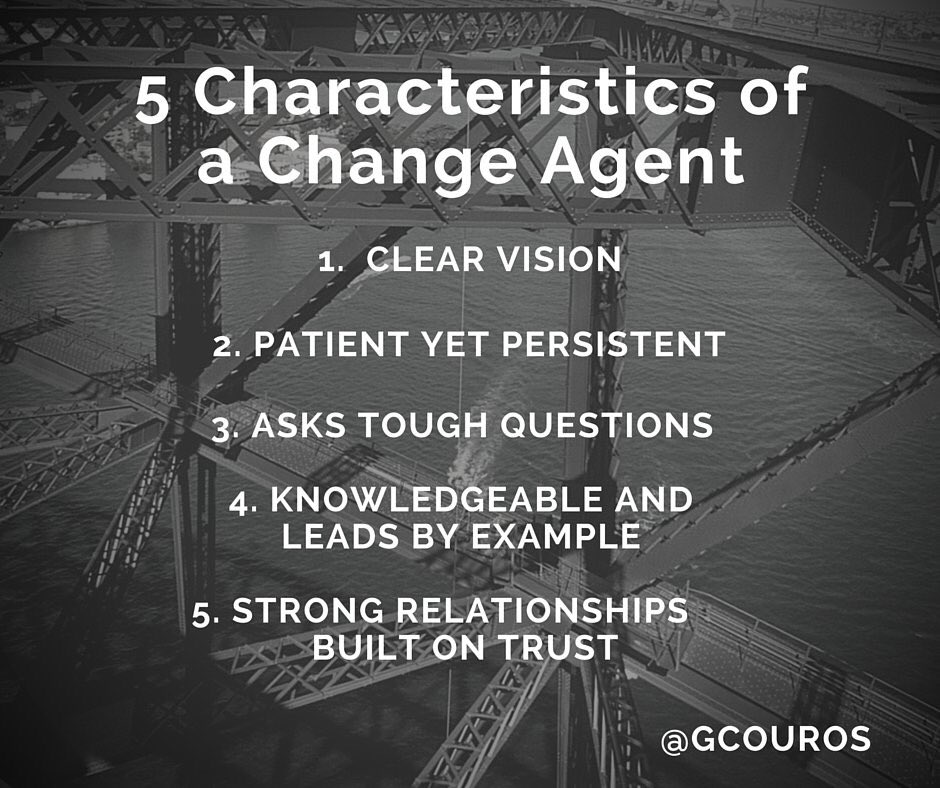
Dru posed a terrific question and I could fill several blog posts on this questions alone. In my role as Director of Educational and Information Technology, as technology moves at a rapid rate; my daily role is slowing things down so that I make pedagogical, budgetary, leadership, and operational decisions based on our collaborative and thoughtful strategic academic plan, not on what is the latest #EdTech product. I have a very clear vision distilled from that academic plan and I am consistently navigating toward those embedded goals. When Dru posed his question this morning, my reply was easy as I have only been successful in realizing my vision because of the relationships I have invested in. Relationships are key in shaping my vision as I am fortunate to work with an amazing leadership team and a strong and creative faculty. If you work toward garnering a strong foundation of trust and can clearly communicate your underlying"why" of your vision, you have a high degree of success likely. Of course, you will need to persist through the challenges that any change brings. I like to think of these challenges as the necessary checks and balances to ensure that you are on the right path. Randy Pausch, author of The Last Lecture, called these challenges "brick walls put there to see how much you really want something'. So persistence is another key characteristic of an effective change agent but that also requires being patient, having a deep well of humor and yet one more key characteristic, a strong EQ. Change is hard and possessing a strong emotional intelligence (EQ) will help you work through some of the more human challenges. Someone in the chat reminded me of the excellent post George Couros (@gcouros) wrote in 2013 that "5 Characteristics of a Change Agent"which summarize the key characteristics of an effective change agent. 


Q2 7:44 How do you create and sustain change as a school leader?


While persistence is key, you need to lead by example. Sometimes that means you are a cheerleader, sometimes a shepherd and every once a while, a wrangler. All of this requires that you take care of yourself as you will need a lot of stamina on those more challenging days. @BeckettHaight is right though, you need to set your priorities and keep the end in mind. 


Q3 7:52 What is one reform that you are working on at your school? Why is that so critical?


Staying true to your vision and mission through a collaborative and thoughtful academic strategic plan provides a fairly clear road map toward achieving your goal (s). Design Thinking has been and will continue to be a focus as it builds nicely upon of culture of visible thinking and moves us closer to creating a culture where asking the right question is more valued than giving a "right" answer.
 

 It was fascinating to see the breadth of reforms that schools/organizations are working on from grading to innovation to technology usage. Change is hard but realizing how many educators are in similar positions to your organization is helpful.Virtual support and guidance abounds in twitter making it the best source of professional development.


Q4 8:00 What resources (tech, articles, books, protocols) do you use to foster change and reform? 

  My PLN is a formidable resource and sounding board but don't forget the community around you. take time to ask tough questions as George Couros suggests and listen with an open heart to the feedback of your team. Sometimes the feedback may not be what you want to hear but if you have a strong team, they will keep you honest.


Q5 8:08 How do you help external stakeholders (families, district) understand and work on school change efforts? 

 
Communication is key but you need to remember that communication must be two way. Seeking feedback from all your stakeholders is essential. Although this tweet occurred earlier in the chat, @jbhanlon underscores the need to develop a supportive culture where all voices and input are welcome.


Q6 8:18 If reform was a food for schools, what kind of food would it be and why?

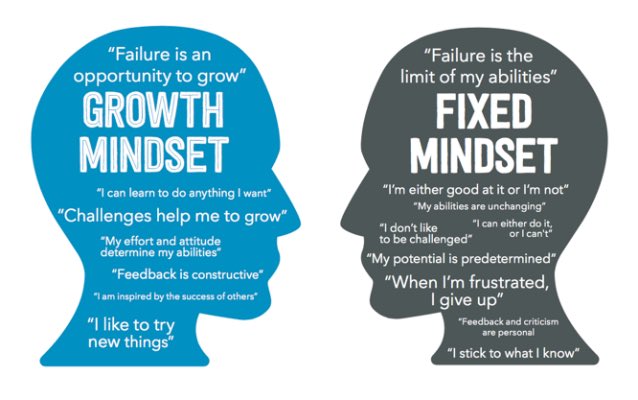
  In the end, I believe that above all else, transformational leaders have a growth mindset and encourage this culture in those around them. I love this image below posted by @miriamcheuk today. Transformational leaders enable change because they themselves believe in growth,  they understand the risk of change but they also believe in being bold and taking worthwhile risks.  Be bold, listen, lead with your mind and with your heart and in the end, keeping a focus on what is best for your students will provide the right culture to change when necessary. 


Sunday, March 11, 2012

Game Change Leadership


I watched the HBO "docudrama", Game Change, last night. The production portrays Sarah Palin as a charismatic leader who is seemingly clueless about foreign policy, national policy and geography. While the campaign staff is impressed with her amazing ability to connect with people, she doesn't seem to have the necessary credentials to lead the country. The campaign manager and his staff try to bring her up to speed by supplying her with canned responses to areas where she may lack the necessary knowledge and experience to answer a question. Whether it is true or not, we all know of leaders who are charismatic yet seem to demonstrate scant understanding of their field and you wonder, how did these people rise to the top?

It started me thinking about educational leadership. How many Principals or Head of Schools truly can not only talk the talk, but walk the walk? I have been fortunate to always work with leaders whose depth and breadth of experience and knowledge make their schools shine (my current school is a great example of this strong leadership). While one could contend that charisma is a necessary component of leadership, I would argue that knowledge, expertise, emotional intelligence, understanding of school mission and vision are of even greater value. The ability to understand how to bring a community together and lift everyone's performance is the magical stuff that I look for in a leader. Judging by low performance we have across the nation in education, perhaps we have set the bar too low. How many of our educational leaders have actually taught? How many of them continue to push themselves to grow professionally? How many of them can greet their students by name at the door? We seem to rate our educational leaders based on their school's achievement level in standardized test scores and college acceptances [or dropout rate depending on your educational environment]. Perhaps it is the way we assess and reward our educational leaders that put so many schools at risk through poor leadership?

Why don't we measure an educational leader's ability to:
  • create a culture of professional learning and collaboration among faculty and staff?
  • increase student, parent, alumni and faculty satisfaction in all facets of school life?
  • demonstrate a consistent personal professional growth?
  • ensure opportunities for all types of learners?
  • demonstrate an understanding of programs and alternative assessments that truly promote critical thinking?
  •  convey a deep understanding of curriculum, learning styles and best practices?
  • demonstrate a deep knowledge of his or her community?

If we agree that focusing on the wrong way to assess student success is how we are failing our children, then we need leaders who are knowledgeable, passionate, experienced and who are capable of steering their schools in the right direction for the betterment of all students. We need leaders who know their students, teachers and parents; who know what is going on in every area of school life because they are out there making those connections; and who are not afraid to drive change where needed. We need leaders who have more to offer than charisma.


Tuesday, July 5, 2011

Mad Love for Tony Wagner


    I admit it, I have an intellectual crush on Tony Wagner. I {> him. My friends and colleagues are sick to death hearing about me extol the virtues of the mighty TW. Don't get me wrong, I have great respect for Daniel Pink, John Medina, Richard Arum, Mihaly Csikszentmihalyi, Carol Tomlinson, Jay McTighe, etc. but I always come back to Tony Wagner. He hits the nail on the head as far as how we need to THINK about students, learning, change, leadership, education  . . . it's not what is taught that matters, it is what is learned.

 Teaching ALL students NEW skills is a new education challenge that requires development of new accountability structures, different ways of teaching and testing, and new ways of working together and with our students. The Global Achievement Gap by Tony Wagner.

     In case you are not familiar with The Global Achievement Gap, Tony suggests that there are seven survival skills our students need to learn in order to be successful 21st century citizens: 


1.Critical Thinking and Problem-Solving

2.Collaboration Across Networks and Leading by Influence

3.Agility and Adaptability

4.Initiative and Entrepreneurialism

5.Effective Oral and Written Communication

6.Accessing and Analyzing Information

7.Curiosity and Imagination

     He advocates for schools to develop strategies for instruction/assessment of the BIG 3 C's:
  1. critical and creative thinking
  2. communication
  3. collaboration

     Thanks to social media, we can accomplish this challenge. Really. It's not rocket science. We just need to move out of our comfort zone. How about all those A.P. classes? If we must have them, then does it take all that much energy to push students to ask the right questions past the same old Powerpoint presentation? Maybe ask those questions across collaborative networks? To communicate those answers articulately (through Skype classrooms?), concisely (through Twitter?),  and creatively (well, pick your favorite medium . . . I think we have some choice here). Pat Bassett, president of NAIS, wrote a great riff off these ideas: Demonstrations of Learning for 21st Century Schools. (Really wonderful, insightful article.)

     So yes, I am a FAN. I cannot wait until Tony's new book comes out: Learning to Innovate, Innovating to Learn: What The Best Parents, Teachers & Employers Do And Why It Matters AND I am hoping to catch the documentary about his experience touring Finland's schools, The Finland Phenomenon (see interview at Huff Post   http://www.huffingtonpost.com/c-m-rubin/finland-education_b_868781.html.) 

     Tony is still at Harvard, but in a new position, Innovation Education Fellow at the Technology & Entrepreneurship Center at Harvard. If you are interested in some great summer reading, The Global Achievement Gap is in paperback and IBooks. Enjoy!